
Door Frame Assembly Machine
Professional door frame production equipment with high efficiency and precision.
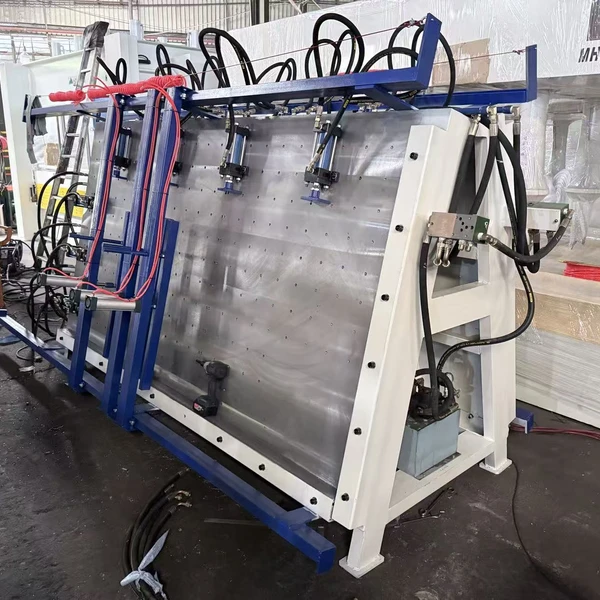
The door frame assembly machine turns the assembly and pressing of door leaves, cabinet doors and furniture frames into a single station. Front, rear and side cylinders press simultaneously, clamping and setting the glued joints in one cycle, so 90-degree corners are evenly loaded — no gaps, no cracks. Compared with manual mallet-and-wedge assembly, the machine delivers accurate angles and consistent batch quality.
Sizing a door frame machine comes down to maximum assembly size: the MH2210 assembles frames up to 1220×2440mm — a standard door leaf in one go. For oversized frames or full wardrobe frames, send us your largest frame dimensions and we will size the machine to the upper limit so big frames always fit.
Key Features
- Front, rear and side cylinders press simultaneously — clamping and setting in one cycle
- Maximum assembly size 1220×2440mm — a standard door leaf assembled in one pass
- Evenly loaded 90-degree corners — no gaps, no cracks, consistent angles across batches
- Station-based operation — one loader and one unloader can run the group
- Handles door leaves, cabinet doors, solid-wood windows/doors and furniture frames
Please Provide the Following for Quotation
- Frame type (door leaf / cabinet door / window frame / furniture frame) and largest dimensions
- Frame thickness and member cross-section sizes
- Daily frame output and assembly cycle time
- Gluing method (manual / with a glue applicator)
- Whether a turntable or twin-station alternating operation is needed
FAQ
How many frames per cycle?
The standard practice is one frame per cycle for maximum clamping force and the most accurate angles; for small frames (cabinet doors, drawer frames), several can be laid side by side and pressed together, with the count set by frame size. Send us your most common frame size list and we will calculate output per cycle and per shift.
Can it press irregular or angled frames?
The standard machine presses 90-degree rectangular frames. Angled frames (45-degree miter frames, architrave moldings) can be handled by swapping the positioning fixture; fully irregular curved frames are not suited to machine pressing and are better done with segmented clamps. Send us your frame drawings and we will judge whether and how it can be pressed.
Is gluing done manually or with matching equipment?
For small batches, glue manually then press; for steady batches we recommend adding a glue applicator — more even glue spread and more consistent joint strength. We build the gluing step into the station layout and can supply the applicator together with the machine.
How does it connect to a full door production line?
The typical flow: ripping → profiling/grooving → gluing → door frame assembly press → curing rest → sanding → facing or painting. The assembly machine takes the gluing station before it and the curing racks and sanding section after it. When we plan a full line, we pace the assembly machine together with upstream and downstream stations so nothing bottlenecks.